
The Post-Holiday Hiring Spike and Its OFCCP Documentation Impact
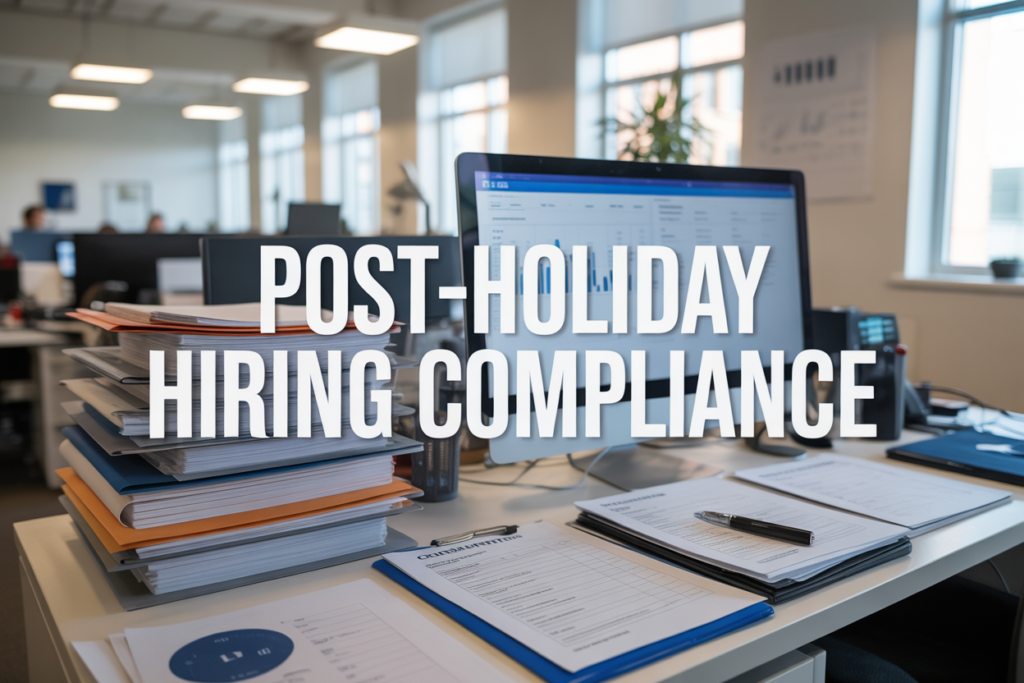
January brings the post-holiday hiring spike that catches many federal contractors off guard. This surge in recruitment activity creates unique challenges for maintaining OFCCP compliance documentation while moving at breakneck speed to fill open positions.
This guide is for HR professionals, compliance officers, and hiring managers at federal contracting companies who need to balance rapid hiring with strict regulatory requirements. You’ll learn how to handle the documentation demands that come with high-volume recruitment compliance without slowing down your hiring process.
We’ll cover why the post-holiday hiring surge happens and what it means for your OFCCP documentation requirements. You’ll also discover practical strategies for building documentation systems that work during accelerated hiring processes, plus common pitfalls that trip up even experienced compliance teams when hiring volume suddenly jumps.
Understanding the Post-Holiday Hiring Surge Phenomenon
Peak Recruitment Periods Following Holiday Seasons
The weeks immediately after major holidays create a perfect storm for hiring activity. January through March represents the busiest recruitment season for most organizations, with job postings typically increasing by 40-60% compared to December levels. This post-holiday hiring surge stems from budget renewals, delayed hiring decisions, and fresh organizational priorities that companies shelve during the holiday slowdown.
Companies often pause hiring between mid-November and early January, creating pent-up demand that surges once the new year begins. HR departments find themselves managing dozens of open positions simultaneously, while candidates who postponed job searches during the holidays flood the market with applications. This convergence creates an intense recruitment period that can overwhelm even well-prepared organizations.
Industry Sectors Experiencing Maximum Hiring Activity
Retail and hospitality sectors lead the post-holiday hiring spike, often increasing staff by 25-40% to handle returns, exchanges, and new year shopping patterns. Technology companies capitalize on fresh budgets and project launches, typically posting 50% more positions in January than in any other month.
Healthcare facilities are ramping up hiring to address staffing shortages exacerbated by holiday burnout and flu-season demands. Manufacturing and logistics companies expand teams to handle increased production schedules after holiday manufacturing lulls. Financial services organizations launch major hiring initiatives aligned with fiscal year planning and regulatory requirements.
Professional services firms, particularly consulting and accounting practices, accelerate recruitment to meet growing client demands and replace departing staff who often leave after receiving year-end bonuses.
Statistical Trends in January-March Recruitment Cycles
Industry data show that January consistently ranks as the highest-volume hiring month, with job postings up 65% from December levels. February maintains momentum with 45% higher activity, while March sustains elevated hiring at 35% above baseline levels.
Federal contractors experience even more dramatic spikes, with some organizations reporting 200-300% increases in application volumes during peak post-holiday weeks. This creates significant challenges for OFCCP compliance documentation, as standard review processes struggle to keep pace with accelerated timelines.
Application-to-interview ratios shift dramatically during this period, often dropping from typical 10:1 ratios to 15:1 or higher, requiring more sophisticated screening and documentation processes to maintain compliance standards.
Economic Factors Driving Increased Job Market Activity
Budget cycle renewals provide the primary economic driver behind post-holiday hiring spikes. Organizations receive fresh funding allocations and can finally execute hiring plans delayed from the previous year. Annual performance reviews and strategic planning sessions identify staffing gaps that require immediate attention.
Economic optimism typically peaks in January as companies assess market conditions and growth opportunities for the coming year. Consumer spending patterns normalize after holiday fluctuations, providing clearer revenue forecasts that support hiring decisions.
Competitive pressures intensify as organizations race to secure top talent who are simultaneously active in the job market. Companies accelerate hiring timelines to avoid losing candidates to competitors, creating additional pressure on compliance documentation processes that federal contractors must navigate carefully during these high-volume periods.
OFCCP Compliance Requirements During High-Volume Hiring
Mandatory documentation standards for federal contractors
Federal contractors face strict OFCCP documentation requirements that become even more critical during post-holiday hiring spikes. Every recruitment action must be documented with precision, from job posting approvals to final hiring decisions. The contractor must maintain detailed records of the entire selection process, including position descriptions, recruiting sources, interview notes, and the reasons for each hiring decision.
During high-volume recruitment periods, contractors often rush through documentation steps, creating significant compliance risks. Each job opening requires complete records demonstrating good faith efforts to recruit qualified minorities and women. This includes documenting outreach activities, maintaining copies of job postings across various platforms, and keeping detailed logs of recruitment sources and their effectiveness.
The documentation must also include the selection criteria established before the recruitment process begins. Any changes to these criteria during accelerated hiring processes must be thoroughly documented with clear business justifications. Contractors should establish standardized templates and checklists to ensure consistency across all hiring managers, especially when multiple departments simultaneously recruit during seasonal hiring surges.
Applicant flow data collection and tracking obligations
Post-holiday hiring surge periods create complex challenges for accurate applicant flow data collection. Contractors must track demographic information for every individual who expresses interest in employment, regardless of whether they complete the full application process. This becomes particularly challenging when recruitment volumes spike dramatically after the holidays.
The OFCCP requires contractors to collect race, ethnicity, and gender data through voluntary self-identification forms. During high-volume periods, tracking systems often become overwhelmed, leading to incomplete data collection. Contractors must implement robust tracking mechanisms that can handle increased applicant volumes without losing critical demographic information.
Special attention must be paid to applicants who partially complete applications or apply through multiple channels during recruitment spikes. Each interaction must be properly documented and tracked to avoid double-counting or missing applicants entirely. The system should automatically flag incomplete applications and provide reminders to hiring managers about proper data collection procedures.
EEO-1 reporting implications for expanded workforce
Rapid workforce expansion following post-holiday hiring spikes directly impacts EEO-1 reporting accuracy and compliance obligations. Contractors must carefully track new hires by job category to ensure proper classification for reporting. The timing of new-hire start dates is critical, as employees hired in January may affect the entire year’s reporting snapshot.
Accelerated hiring processes often result in compressed onboarding timelines, creating risks to accurate job classification and accurate demographic data collection. New employees must complete all required forms, including voluntary self-identification surveys, before their information can be accurately reflected in EEO-1 reports. Contractors should establish clear cutoff dates and tracking systems to ensure all post-holiday hires are properly categorized.
The expanded workforce may also trigger additional OFCCP obligations if the contractor crosses certain employee thresholds. Companies with 49 or fewer employees or $50,000 or less in federal contracts must prepare for enhanced compliance requirements, including written affirmative action programs and more detailed reporting obligations.
Internet applicant rule compliance during recruitment spikes
Managing internet applicant rule compliance becomes exponentially more complex during post-holiday recruitment spikes when application volumes surge. The four-part test for internet applicants requires contractors to consider individuals who submit expressions of interest online, meet basic qualifications, haven’t removed themselves from consideration, and fall within the contractor’s consideration pool.
During high-volume periods, determining who qualifies as an “internet applicant” becomes challenging when thousands of resumes flood application systems. Contractors must establish clear, consistent criteria for basic qualifications before posting positions, and these standards cannot be modified mid-process to reduce applicant pools. Documentation must show exactly how each criterion was applied and when applicants were eliminated from consideration.
Automated application systems require special attention during recruitment spikes to ensure compliance with internet applicant rules. The system must capture all required data elements and maintain detailed logs documenting when applications were received, reviewed, and disposed of. Contractors should regularly audit their online application processes to ensure they’re not inadvertently creating compliance gaps during periods of accelerated hiring.
Documentation Challenges in Accelerated Hiring Processes
Maintaining Accurate Applicant Tracking Systems Under Pressure
When the post-holiday hiring surge kicks into high gear, your applicant tracking system becomes the backbone of OFCCP compliance documentation. The sheer volume of applications can overwhelm even the most robust systems, resulting in data-entry errors, duplicate records, and incomplete candidate profiles. During these accelerated hiring processes, HR teams often rush to enter data, creating gaps that could lead to issues during an OFCCP audit.
The pressure to fill positions quickly can lead to shortcuts in data collection. Recruiters might skip mandatory fields, fail to properly categorize applicants, or neglect to record disposition codes consistently. These seemingly minor oversights accumulate rapidly when processing hundreds of applications daily. Your ATS needs real-time validation rules and mandatory field requirements to prevent incomplete records from entering the system.
Integration challenges also surface during high-volume recruitment periods. When multiple platforms are feeding candidate data into your primary ATS, synchronization delays or mapping errors can create discrepancies. Job boards, social media recruiting, and employee referral systems must seamlessly integrate to maintain the complete applicant flow documentation required by OFCCP compliance.
Regular system audits become critical during these periods. Daily spot-checks can identify patterns of incomplete data entry before they become systemic issues. Automated reporting features should flag missing information, enabling teams to address gaps immediately rather than discovering them during compliance reviews months later.
Ensuring Consistent Interview Documentation Across Hiring Teams
Scaling interview processes across multiple hiring teams creates significant documentation challenges for federal contractor hiring obligations. Different managers have varying approaches to recording candidate interactions, evaluation criteria, and decision-making rationales. This inconsistency becomes magnified during post-holiday hiring spikes when teams are stretched thin and new temporary staff join the recruiting effort.
Standardized interview forms and evaluation rubrics are essential, but they mean nothing without proper training and enforcement. When hiring volume increases, organizations often bring in additional interviewers or panel members who may not be familiar with OFCCP documentation requirements. These team members might ask inappropriate questions, fail to document their reasoning, or use subjective language that could indicate bias.
The challenge deepens when interviews move to virtual formats or accelerated timelines. Compressed interview schedules can lead to rushed documentation, incomplete notes, or missing evaluations entirely. Phone screenings and video interviews require the same level of documentation as in-person meetings, but the informal nature of these interactions often results in inadequate record-keeping.
Creating interview packet templates with pre-populated job-related questions and structured evaluation sections helps maintain consistency. Each interviewer should receive clear instructions on what must be documented, what language to avoid, and how to justify hiring decisions objectively. Regular calibration sessions ensure that all team members apply the evaluation criteria consistently across candidates.
Managing Adverse Impact Analyses with Increased Candidate Pools
Larger candidate pools during post-holiday recruitment challenges create complex statistical scenarios for adverse impact analyses. The four-fifths rule calculation becomes more sensitive to fluctuations when dealing with hundreds or thousands of applicants across different demographic groups. Small changes in selection rates can push your organization from compliant to non-compliant territory, requiring immediate attention and potential corrective action.
Data accuracy becomes paramount when conducting these analyses with expanded applicant pools. A single misclassified applicant or an incorrectly recorded disposition can significantly skew results. The demographic information collected during the application process must be consistently captured and properly coded in your systems to ensure reliable statistical outcomes.
Timing presents another challenge during accelerated hiring processes. Traditional adverse impact analyses might be conducted quarterly or after major hiring initiatives, but high-volume recruiting may require more frequent monitoring. Weekly or biweekly analyses help identify problematic trends before they become statistically significant issues requiring formal remediation.
Geographic and job category breakdowns add layers of complexity during post-holiday hiring spikes. Organizations often recruit for multiple positions simultaneously across different locations, each requiring separate adverse impact calculations. The statistical significance of smaller subgroups can be affected more dramatically by volume changes, requiring careful monitoring and potential adjustments to recruiting strategies.
Real-time dashboard capabilities become invaluable for tracking selection rates as they develop. Automated alerts can notify compliance teams when selection rates approach concerning thresholds, allowing for immediate intervention rather than reactive damage control.
Strategic Documentation Systems for Post-Holiday Recruitment
Automated tracking solutions for high-volume hiring periods
During the post-holiday hiring surge, manual tracking becomes a recipe for disaster. Companies that handle hundreds of applications daily need robust automated systems that capture every interaction, decision point, and candidate touchpoint without human intervention.
Modern applicant tracking systems (ATS) designed for OFCCP compliance documentation automatically log when applications are received, reviewed, and moved through each stage. These platforms timestamp every action, creating an unbreakable chain of documentation that auditors love to see. The best systems also flag potential compliance issues in real time, such as when a hiring manager hasn’t documented their reasoning for rejecting a candidate from a protected class.
Smart automation goes beyond basic tracking. Advanced systems can automatically generate OFCCP documentation requirements reports, pulling data on application sources, demographics, and hiring outcomes without requiring manual spreadsheet compilation. This becomes crucial in accelerated hiring processes, where HR teams are juggling multiple positions simultaneously.
Integration capabilities matter too. Your automated solution should sync with job boards, social media platforms, and internal referral systems to capture the complete applicant pool. Missing even one source of candidates can create compliance gaps that become problematic during audits.
Standardized interview forms and evaluation criteria
Consistency becomes your best friend when scaling high-volume recruitment compliance. Every interviewer must use consistent evaluation criteria and documentation standards, regardless of whether they’re conducting their first interview of the season or their fiftieth.
Pre-built interview templates should include specific sections for job-related competencies, behavioral assessments, and technical skills relevant to each role. These forms must capture not only the final decision but also the reasoning behind it. When an auditor asks why Candidate A was selected over Candidate B, your documentation should tell that story clearly.
Rating scales need to be uniform across all interviewers and positions. A five-point scale for communication skills means the same thing whether the interview happens in January or March. Training materials should accompany these forms to ensure every team member understands how to apply the criteria consistently.
Digital forms work better than paper during busy periods. They prevent lost documentation, ensure legible notes, and can automatically calculate aggregate scores. Built-in validation rules can prompt interviewers to complete required fields before submitting their evaluations.
Real-time compliance monitoring dashboards
Dashboard visibility transforms OFCCP audit preparation from a reactive scramble into proactive management. Real-time key metrics help HR leaders identify potential issues before they become compliance problems.
Essential dashboard elements include applicant flow data broken down by demographics, time-to-fill metrics by department, and interview-to-hire ratios across different candidate pools. Visual indicators should highlight when any metric falls outside acceptable ranges or when certain groups are being underrepresented in the hiring pipeline.
Alert systems built into these dashboards notify managers immediately when documentation is incomplete or when hiring patterns suggest potential disparate impact. During seasonal hiring compliance periods, these alerts prevent small oversights from snowballing into major compliance issues.
The dashboard should also track documentation completeness across all open positions. Green indicators indicate that all required forms are complete, while red flags highlight missing interview notes or incomplete candidate evaluations requiring immediate attention.
Cross-departmental communication protocols for HR teams
Clear communication channels prevent the classic “left hand doesn’t know what the right hand is doing” scenario that plagues post-holiday recruitment challenges. Structured protocols ensure everyone stays informed about hiring decisions, documentation requirements, and compliance standards.
Daily huddles during peak hiring periods keep everyone aligned on priorities and potential issues. These brief meetings should cover new applications received, interviews scheduled, offers extended, and any compliance concerns that have surfaced. A standardized agenda keeps discussions focused and productive.
Shared digital workspaces allow team members to collaborate on candidate evaluations and share insights about potential compliance risks. When multiple people are involved in hiring decisions, centralized communication prevents important information from getting lost in email chains.
Escalation procedures need to be crystal clear. Team members should know exactly when and how to flag potential issues to compliance specialists or legal counsel. Quick decision-making processes prevent hiring delays while maintaining federal contractor hiring obligations standards.
Regular check-ins with hiring managers outside HR ensure they understand their documentation responsibilities and feel supported during busy periods. These touchpoints help maintain quality standards even when everyone is working at maximum capacity.
Avoiding Common OFCCP Pitfalls During Hiring Spikes
Incomplete Applicant Data Collection Mistakes
During post-holiday hiring surges, companies often rush through applicant data collection, creating significant OFCCP compliance gaps. Many organizations fail to consistently collect required demographic information, including race, gender, and ethnicity data from all applicants. This happens when HR teams use different application systems or revert to informal hiring processes during high-volume periods.
The most common mistake involves collecting voluntary self-identification data from some applicants but not others, creating inconsistent documentation patterns that raise red flags during OFCCP audits. Federal contractors must ensure every applicant receives the same opportunity to provide demographic information, whether they apply through online portals, job fairs, or direct contact with recruiters.
Missing contact information and incomplete application records also plague accelerated hiring processes. When applicants submit partial applications or recruiters fail to capture complete applicant information, the resulting documentation gaps can trigger compliance violations. Companies need standardized data collection protocols that work across all hiring channels, even when processing applications at breakneck speed.
Inadequate Job Posting and Recruitment Documentation
High-volume recruitment compliance suffers when organizations fail to properly document their job posting strategies and recruitment efforts. During post-holiday hiring spikes, companies often expand their recruitment reach without maintaining detailed records of where positions were posted, when postings went live, and how long they remained active.
OFCCP documentation requirements require federal contractors to maintain comprehensive records of all recruitment activities, including job board postings, social media campaigns, and outreach to minority and women-owned organizations. Many companies make the mistake of focusing solely on quickly filling positions while neglecting to document their good-faith efforts to reach diverse candidate pools.
Screenshots of job postings, publication dates, and copies of recruitment advertisements must be systematically collected and stored. Companies that rely on third-party recruiters or staffing agencies often fail to obtain proper documentation from these partners, leaving gaps in their recruitment audit trail that can prove costly during compliance reviews.
Missing Disability and Veteran Status Tracking
One of the most serious pitfalls during seasonal hiring compliance involves failing to consistently collect disability and veteran status information from applicants. The Section 503 and VEVRAA regulations require federal contractors to invite all applicants to voluntarily self-identify their disability status and veteran status at specific points in the hiring process.
During post-holiday recruitment challenges, companies often use expedited application processes that bypass critical data-collection points. Some organizations make the mistake of collecting this information only from hired employees, failing to meet the requirement to gather data from all applicants, regardless of hiring outcome.
The 7% utilization goals for individuals with disabilities and protected veterans require comprehensive applicant data to calculate meaningful metrics. When companies fail to consistently collect this information during high-volume hiring, they cannot accurately assess their progress toward these goals or identify potential barriers in their selection processes.
Improper Handling of Withdrawal and Rejection Records
Federal contractor hiring obligations include maintaining detailed records of all applicant dispositions, including withdrawals and rejections. During accelerated hiring processes, companies often mishandle these critical records, creating compliance vulnerabilities that can trigger OFCCP investigations.
Common mistakes include failing to document the reasons candidates are withdrawn from consideration or inadequately recording the rejection rationale. When hiring managers make quick decisions to keep pace with post-holiday hiring demands, they often skip proper documentation of selection criteria and decision-making processes.
OFCCP audit preparation requires companies to demonstrate that all hiring decisions were based on legitimate, job-related factors. Poor record-keeping during hiring spikes can make it impossible to reconstruct the reasoning behind applicant dispositions, leaving companies unable to defend their hiring practices. Systematic tracking of candidate status changes, interview feedback, and selection committee decisions becomes even more critical during periods of intensive recruitment activity.
Best Practices for Maintaining Compliance Under Pressure
Pre-planning Documentation Workflows Before Hiring Surge
Smart organizations know that post-holiday hiring spikes are predictable. January through March consistently see the highest volume of recruitment activity, making advance preparation essential to maintain OFCCP compliance documentation standards. Developing streamlined workflows before the rush begins prevents the scrambled, error-prone processes that often emerge during high-pressure periods.
Create standardized templates for all critical documentation touchpoints. Job posting requirements, interview evaluation forms, and candidate rejection letters should follow consistent formats that automatically capture required compliance data. Build these templates with mandatory fields that prevent incomplete submissions and include dropdown menus for common rejection reasons to maintain consistency across hiring teams.
Map out your entire recruitment process flow, identifying every point where OFCCP documentation requirements intersect with hiring decisions. This includes initial job postings, candidate sourcing activities, interview scheduling, evaluation processes, reference checks, and final selection documentation. Each step should have clear protocols that hiring managers can follow without extensive deliberation during busy periods.
Establish automated workflows within your applicant tracking system that trigger compliance reminders at critical decision points. When a hiring manager moves to reject a candidate, the system should prompt them to select appropriate reasoning and documentation. These safeguards prevent the common oversight of missing documentation that often occurs when teams rush to fill positions.
Training Hiring Managers on Accelerated Compliance Procedures
Hiring managers become the front line of OFCCP compliance during post-holiday hiring surges, yet many lack a comprehensive understanding of federal contractor hiring obligations. Regular training sessions focused on accelerated hiring processes help managers effectively balance speed with compliance requirements.
Develop scenario-based training modules that simulate high-volume recruitment situations. Use real examples from previous hiring spikes to demonstrate common compliance challenges and their solutions. Role-playing exercises where managers practice documenting hiring decisions under time pressure build muscle memory for proper procedures.
Focus training on the most critical compliance areas that are most at risk during rush periods. Interview documentation, candidate evaluation consistency, and proper rejection reasoning require special attention. Many managers understand these concepts in theory but struggle to apply them correctly when managing multiple open positions simultaneously.
Create quick-reference guides that hiring managers can access during active recruitment. These should include step-by-step checklists for common scenarios, template language for various situations, and contact information for immediate compliance support. Mobile-friendly formats allow managers to reference these materials while conducting interviews or making hiring decisions remotely.
Regular refresher sessions throughout the hiring surge help maintain compliance awareness. Brief weekly check-ins can address emerging challenges and reinforce proper documentation practices without disrupting the recruitment momentum.
Implementing Quality Assurance Checkpoints Throughout the Process
Quality assurance checkpoints serve as safety nets that catch compliance gaps before they become audit liabilities. Strategically placing these checkpoints throughout your accelerated hiring processes helps ensure consistent OFCCP documentation standards, even when individual team members feel overwhelmed.
Institute daily file reviews during peak hiring periods. Assign dedicated compliance specialists to audit completed hiring documentation within 24 hours of each hiring decision. This rapid review process allows for immediate correction of documentation deficiencies while details remain fresh in hiring managers’ minds.
Build automated system checks that flag potential compliance issues in real-time. Modern applicant tracking systems can identify incomplete candidate files, missing interview documentation, or inconsistent evaluation patterns. These alerts prompt immediate attention to specific files before they become problematic.
Establish peer-review protocols in which senior hiring managers validate junior colleagues’ documentation. This cross-checking system distributes quality-control responsibilities while providing learning opportunities for less-experienced team members. Pair high-performing managers with those who struggle with compliance documentation to create mentorship opportunities.
Weekly compliance scorecards track team performance across key documentation metrics. Monitor completion rates for required forms, consistency in candidate evaluation scoring, and timeliness of documentation submission. Public recognition for teams maintaining high compliance standards during busy periods reinforces positive behaviors.
Creating Backup Systems for Critical Compliance Data
System failures and data loss can devastate OFCCP compliance efforts, especially during high-volume recruitment periods when recreating documentation becomes nearly impossible. Robust backup systems protect critical compliance data and provide alternative access methods when primary systems experience issues.
Implement redundant storage for all recruitment documentation across multiple platforms. Cloud-based systems with automatic synchronization ensure that hiring documentation remains accessible even if primary servers fail. Regular backup verification confirms that stored data remains intact and retrievable when needed.
Develop offline documentation procedures for situations where electronic systems become unavailable. Paper-based backup forms should capture the same essential compliance information as digital versions, with clear protocols for transferring this data once systems resume normal operation. Train hiring teams on these manual processes before they become necessary.
Create alternative access points for critical compliance data through multiple user interfaces. If your primary applicant tracking system becomes inaccessible, secondary platforms should provide hiring managers with essential candidate information and documentation capabilities. Mobile applications can serve as backup access points when computer systems face issues.
Establish data recovery partnerships with IT specialists who understand OFCCP compliance requirements. Quickly restoring lost documentation requires technical expertise and knowledge of federal contractor hiring obligations. These partnerships ensure that recovery efforts prioritize the most compliance-critical information first.
Regular disaster recovery testing validates the effectiveness of backup systems before emergencies occur. Simulate various failure scenarios during slower hiring periods to identify weaknesses in backup protocols and train teams on alternative procedures.
The post-holiday hiring rush brings real opportunities to strengthen your workforce, but it also creates serious compliance risks that can hurt your company later. Companies that get caught up in the excitement of rapid hiring often forget about proper OFCCP documentation, leading to costly violations and legal headaches down the road. The key is having strong systems in place before the hiring spike hits, so your team can move quickly while still tracking everything they need to track.
Smart companies treat OFCCP compliance as part of their hiring strategy, not an afterthought. Establish clear documentation processes, train your hiring managers on which records to keep, and schedule time for compliance checks into your recruitment timeline. When you balance speed with proper record-keeping, you’ll not only avoid regulatory issues but also build a more effective hiring process that works year-round.
Expanding your recruiting reach means pairing automation with smart platform integration. Explore our Google for Jobs, ZipRecruiter, and Handshake integrations to boost visibility, and visit the Programmatic Job Advertising category for tips on improving distribution performance. Whether you’re building early-career pipelines or scaling national hiring, Job Multiposter and Job Distribution help automate workflows and drive measurable recruiting results.