
Top Job Board Mistakes That Kill Your Apply Rate
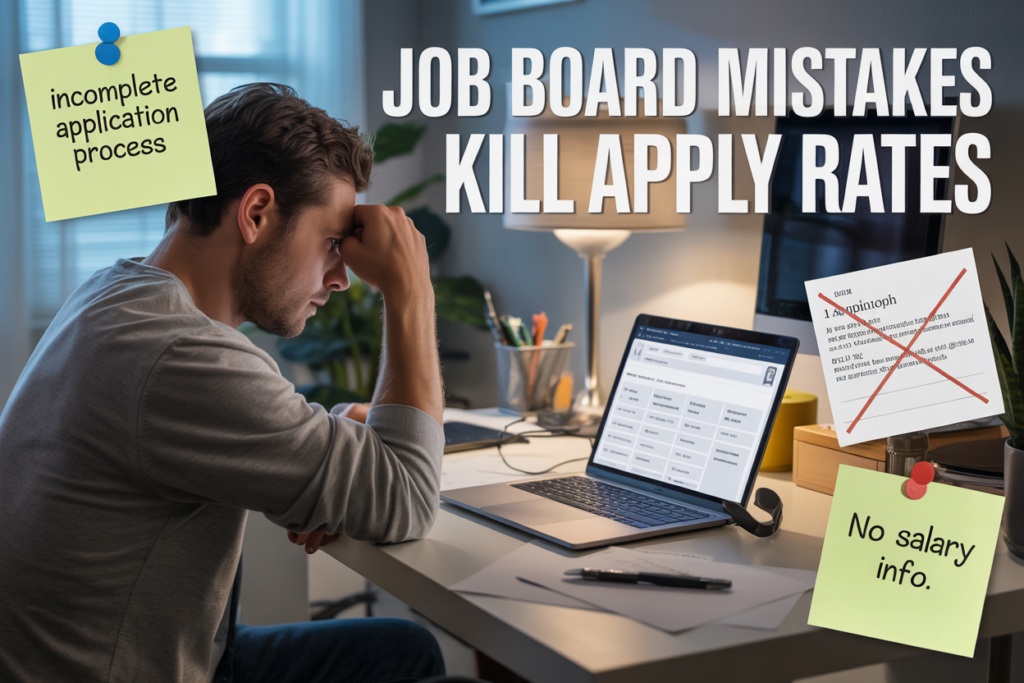
Your job board application rate is tanking, and you’re not sure why. If you’re a hiring manager, recruiter, or HR professional struggling to get quality candidates to click “apply,” you’re dealing with fixable problems that cost you top talent every day.
Most companies unknowingly sabotage their own recruitment efforts through typical job posting mistakes that kill candidate interest. Poor job descriptions, hidden application barriers, and weak employer branding create a broken hiring funnel that turns qualified candidates away before they even consider your role.
This guide reveals the most significant job board optimization mistakes that destroy your recruitment conversion rates. We’ll show you how application process barriers drive candidates to your competitors and why compensation transparency problems make top talent skip your posts entirely. You’ll also discover how poor employer branding for recruitment damages your credibility and what you can do to fix it fast.
Poor Job Post Visibility and Discoverability Issues
Using Generic Job Titles That Don’t Match Search Terms
Your job title is the first thing candidates see, and using generic labels like “Marketing Associate” or “Sales Representative” won’t cut it in today’s competitive market. Job seekers search for specific terms that match their experience and career goals. When you post a “Software Engineer” position, but candidates are searching for “React Developer” or “Full Stack JavaScript Developer,” you’re missing out on qualified applicants who never find your listing.
Research shows that specific, keyword-rich job titles receive 30% more applications than generic alternatives. Instead of “Customer Service Representative,” try “Remote Customer Success Specialist” or “Technical Support Agent.” This approach improves your job post visibility by aligning with actual search behavior and helps candidates quickly identify if the role matches their skills.
Consider what terms your ideal candidate would type into a search bar. If you’re hiring for a marketing role focused on social media, “Social Media Marketing Manager” will outperform “Marketing Specialist” every time. The more specific and descriptive your title, the better your chances of appearing in relevant search results.
Inadequate SEO Optimization for Job Board Algorithms
Job boards operate like search engines, using complex algorithms to rank and display postings. Many employers ignore this reality, treating job descriptions like internal documents rather than content designed to attract and engage candidates. Poor SEO practices directly impact your job board optimization efforts and reduce your reach to qualified applicants.
Keywords matter enormously in job descriptions. If you’re hiring a project manager but never mention “project management,” “Agile,” “Scrum,” or “stakeholder coordination,” your posting won’t appear when candidates search for these terms. Job board algorithms scan your entire posting for relevant keywords and phrases, not just the title.
Location-specific keywords also boost visibility. Instead of just listing “New York,” include “NYC,” “Manhattan,” “Brooklyn,” or “Greater New York Area” to capture different search variations. Remote work options should be clearly stated since “remote,” “work from home,” and “telecommute” are extremely popular search terms.
Industry-specific jargon and technical terms should appear naturally throughout your description. For a data analyst position, include terms like “SQL,” “Python,” “data visualization,” “analytics,” and “business intelligence.” This strategy helps your posting rank higher when candidates search for specific skills and technologies.
Poor Posting Timing That Misses Peak Candidate Activity
Timing your job posts strategically can increase your application rate by up to 50%. Most employers post whenever it’s convenient for them, completely ignoring when candidates are actually browsing job boards. This oversight wastes your posting budget and reduces the number of qualified applicants you’ll receive.
Tuesday through Thursday are the golden days for job posting, with Tuesday showing the highest engagement rates. Candidates typically browse job boards during work hours, especially between 10 AM and 2 PM, when they can discreetly search from their current workplace. Monday mornings are busy catch-up times, while Friday afternoons see reduced activity as people wind down for the weekend.
Seasonal patterns also affect candidate behavior. January and September are peak job-hunting months as people make New Year career changes or return from summer vacations with renewed focus. During holiday periods, activity drops dramatically, so posting during Thanksgiving week or between Christmas and New Year’s wastes your visibility window.
Consider your industry’s specific patterns too. Education professionals search heavily in spring and early summer, while retail hiring peaks before major shopping seasons. Understanding these cycles helps you time your posts when your target candidates are most active and motivated to apply.
Insufficient Job Board Selection Strategy
Many companies default to posting on the biggest, most expensive job boards without considering where their ideal candidates actually spend their time. This scattershot approach wastes budget and fails to reach specialized talent pools. Different job boards attract different demographics, skill levels, and career focuses.
LinkedIn dominates for professional and management roles, while Indeed captures a broader audience, including entry-level positions. Stack Overflow and GitHub Jobs excel for technical roles, while AngelList attracts startup-minded candidates. Industry-specific boards like Dice for tech professionals or CreativeJobs for marketing roles often deliver better quality candidates than general platforms.
Geographic considerations matter too. Regional job boards often offer better access to local talent than national platforms. College job boards connect you directly with recent graduates, while professional association job boards reach experienced industry veterans. Niche boards typically have less competition, so your posts get more visibility for less money.
Budget allocation across multiple platforms usually outperforms allocating all resources to a single, expensive board. Testing different combinations helps you identify which platforms deliver the best return on investment for your specific roles and company type. Track metrics like application volume, candidate quality, and cost-per-hire to optimize your job board selection strategy over time.
Weak Job Descriptions That Fail to Attract Candidates
Overly Complex Language and Industry Jargon
Job descriptions packed with unnecessary jargon and complex terminology create an instant barrier between you and potential candidates. When you write about “synergistic solutions” and “paradigm shifts,” you’re essentially speaking a foreign language to many qualified applicants who could excel in the role.
The biggest culprit? HR departments and hiring managers who think impressive vocabulary equals impressive company culture. Reality check: candidates spend an average of 14 seconds scanning job posts before deciding whether to continue reading. If they can’t quickly understand what you actually want them to do, they’ll move on to the next opportunity.
Simple language doesn’t mean dumbing down your content. It means being crystal clear about expectations. Instead of “facilitate cross-functional collaboration to optimize deliverables,” try “work with different teams to complete projects on time.” The second version communicates the exact requirement while being instantly understandable.
Industry jargon creates another problem: it excludes potentially great candidates from adjacent industries or career changers who bring fresh perspectives. When you use highly technical language unnecessarily, you’re essentially putting up a “members only” sign that reduces your candidate pool.
Missing Essential Job Requirements and Qualifications
Nothing tanks job board apply rates faster than vague, incomplete job requirements that leave candidates guessing what you actually need. When job descriptions read like wish lists rather than realistic requirements, you create confusion that drives qualified candidates away while attracting unqualified ones.
The most common mistake? Failing to distinguish between “must-have” and “nice-to-have” qualifications. When everything appears equally important, candidates either assume they’re underqualified (and don’t apply) or overqualified applicants flood your inbox because they can’t gauge the actual difficulty level.
Missing salary ranges compound this problem. Research shows that job postings without compensation information receive 30% fewer applications than those with transparent pay details. Candidates want to know if the opportunity aligns with their financial expectations before investing time in applications.
Technical requirements deserve special attention. Listing “proficiency in Microsoft Office” tells candidates nothing meaningful in 2024. Instead, specify which programs they’ll actually use and at what level. “Advanced Excel skills, including pivot tables and data analysis,” gives candidates a clear benchmark for self-assessment.
Location flexibility information is equally critical. Remote work options, hybrid schedules, or specific office requirements must be explicitly mentioned. Candidates won’t waste time applying for positions that don’t align with their work-life preferences when there are hundreds of other opportunities that do.
Lack of Compelling Company Culture Information
Generic company culture descriptions kill candidate interest faster than almost any other job description mistake. When every company claims to have “collaborative teams,” “innovative environments,” and “work-life balance,” these phrases become meaningless noise that fails to differentiate your opportunity.
Candidates want authentic glimpses into daily work life, not marketing speak. Instead of saying you have a “dynamic startup culture,” describe specific examples: “Weekly team lunches where everyone shares project wins,” or “Flexible PTO policy where team members actually use their vacation days.” These concrete details help candidates visualize themselves in your environment.
Company values without context mean nothing. Saying you value “integrity and innovation” tells candidates nothing about how these values play out in real workplace situations. Better approach: “When our developer spotted a potential security issue last month, leadership immediately allocated resources to fix it, even though it meant delaying a product launch.”
Career development opportunities need specific details, too. “Room for growth” is corporate speak that every company uses. Instead, mention actual advancement paths: “Our last three marketing managers were promoted to director roles within 18 months,” or “We budget $2,000 annually for each employee’s professional development.”
Missing information about team dynamics and management style leaves candidates wondering about the day-to-day experience. Brief mentions of management philosophy, meeting cadence, and collaboration tools give insight into whether candidates would thrive in your specific environment.
Application Process Barriers That Drive Candidates Away
Lengthy Multi-Step Application Forms
Complex application processes are the fastest way to lose qualified candidates. When job seekers encounter forms that ask for detailed work histories, multiple essay questions, and redundant information already covered in their resumes, most simply click away. Research shows that applications that take more than 5 minutes to complete experience a 50% drop in completion rates.
The worst offenders ask candidates to manually re-enter information that’s already in their uploaded resume or LinkedIn profile. This creates unnecessary friction and sends the message that you don’t value their time. Innovative companies streamline their job board application rate by implementing one-click applications or simple forms that capture only essential information upfront.
Technical Glitches and Mobile Unfriendly Interfaces
Mobile devices account for over 60% of job searches today, yet many application systems still function poorly on smartphones and tablets. Broken links, forms that don’t load properly, or submit buttons that don’t work create immediate barriers that tank your candidate application process.
Common technical issues include file upload failures, session timeouts during lengthy applications, and interfaces that don’t scale properly on smaller screens. These problems don’t just frustrate candidates – they communicate that your organization lacks attention to detail and modern technical standards.
Requiring Excessive Personal Information Upfront
Asking for Social Security numbers, detailed salary histories, or personal demographic information in initial applications raises red flags for candidates. This approach not only creates privacy concerns but also suggests poor boundaries and potentially discriminatory practices.
Successful job board optimization focuses on collecting only the information needed to evaluate basic qualifications initially. Personal details, references, and sensitive information should be requested only after initial screening conversations, when mutual interest has been established.
Missing Clear Application Instructions
Vague or missing instructions leave candidates guessing about what’s expected, leading to incomplete applications or qualified candidates abandoning the process entirely. Instructions should clearly state the required documents, preferred file formats, application deadlines, and any specific questions that need to be addressed.
When candidates don’t understand next steps or timelines, they often apply elsewhere rather than risk missing opportunities. Clear, specific guidance throughout the process improves recruitment conversion rates and candidate experience quality.
No Application Status Updates or Confirmation
Radio silence after applications creates anxiety and leaves a poor impression of your organization. Candidates invest time and effort in applying and deserve acknowledgment that their applications were received and will be reviewed.
Automated confirmation emails and periodic status updates keep candidates engaged and maintain positive perceptions of your employer brand, even if they’re ultimately not selected. This simple courtesy significantly impacts your overall hiring funnel optimization.
Compensation and Benefits Transparency Problems
Hidden Salary Information That Creates Distrust
The days of “salary commensurate with experience” are over. When you hide salary information, candidates immediately assume you’re either underpaying or trying to lowball them. This secrecy creates an instant barrier that damages your job board application rate before candidates even read the full description.
Competent candidates research market rates and know what they’re worth. When they see your posting without salary details, they often skip it entirely rather than waste time on a potentially underwhelming offer. You’re losing quality applicants who might have been perfect fits if they’d known the actual compensation aligned with their expectations.
Even worse, salary transparency laws are spreading across states and countries. Companies that don’t proactively include this information appear behind the times or potentially non-compliant. This perception immediately hurts your employer brand and makes you look less attractive than competitors who openly share compensation details.
Vague Benefits Descriptions Without Specific Details
“Competitive benefits package” tells candidates absolutely nothing. This generic phrase has become so overused that it’s essentially meaningless. Candidates want concrete details about what you’re actually offering, not marketing fluff that could mean anything from basic health insurance to comprehensive wellness programs.
Break down your benefits specifically. Instead of saying “health coverage,” mention “100% company-paid health, dental, and vision insurance” or “health insurance with $500 deductible and company HSA contribution.” Rather than “flexible time off,” specify “unlimited PTO with 15-day minimum requirement” or “4 weeks vacation plus 10 sick days.”
This job posting mistake costs you applications from candidates who assume your vague descriptions hide below-average offerings. Meanwhile, companies that detail their benefits – even if they’re modest – build trust and attract people who value transparency over promises.
Unrealistic Salary Ranges for Required Experience Level
Nothing kills your credibility faster than asking for a senior developer with 8+ years of experience and offering an entry-level salary. These mismatched expectations signal that you either don’t understand market rates or you’re hoping to find someone desperate enough to accept below-market pay.
Candidates quickly recognize these unrealistic combinations and move on to opportunities that properly value their skills. You end up with applications from either underqualified candidates or people who haven’t researched their market value – neither of which helps your recruitment conversion rates.
This disconnect also suggests poor planning within your organization. If you can’t budget appropriately for the level of talent you need, candidates question whether you’ll deliver on other promises, such as career development, resources, or company stability. The salary-to-experience mismatch becomes a red flag for deeper organizational issues.
Poor Employer Branding That Damages Credibility
Outdated Company Information and Logo
Your company profile is often the first impression candidates get of your organization. When job seekers encounter outdated logos, stale company descriptions, or information that hasn’t been refreshed in years, they immediately question your attention to detail and professional standards. A faded 2015 logo or a company overview that still mentions your “innovative new mobile app” from three years ago sends the wrong message.
Modern candidates research potential employers extensively before applying. They want to work for companies that appear current, dynamic, and well-managed. Outdated branding suggests your organization might be stuck in the past or lacks the resources to maintain basic marketing materials. This perception alone can significantly reduce your job board application rate, as top talent gravitates toward employers who appear forward-thinking and professional.
Negative Online Reviews Left Unaddressed
Glassdoor reviews, Google ratings, and social media comments don’t disappear on their own. When candidates research your company and find a string of negative reviews without any management responses, they assume you don’t care about employee feedback or workplace culture. Clever employer branding for recruitment requires active reputation management.
The most damaging aspect isn’t necessarily the negative reviews themselves—most candidates understand that every company faces challenges. What kills applications is management’s radio silence. When former employees complain about toxic leadership or poor work-life balance and receive no response, current job seekers assume those problems still exist and remain unaddressed.
Responding professionally to criticism shows you value feedback and take employee concerns seriously. Even a simple acknowledgment that you’re working to improve specific areas can transform a negative review into a positive indicator of your company’s growth mindset.
Inconsistent Messaging Across Different Platforms
Your LinkedIn company page promises flexible remote work, but your job board posting mentions “office-based position.” Your website describes you as a “fast-paced startup,” while your Indeed profile describes you as a “stable, established company.” These contradictions create confusion and erode trust before candidates even submit their applications.
Consistency builds credibility. When your messaging aligns across platforms, candidates develop confidence in your organization’s authenticity and transparency. Mixed messages suggest either poor internal communication or, worse, deliberate misrepresentation of your company culture and values.
Audit your presence across all platforms quarterly. Your tone, values, benefits, and company culture should tell the same story whether someone finds you on LinkedIn, your career page, or external job boards. This alignment significantly improves recruitment conversion rates by building trust with potential applicants.
Missing Employee Testimonials and Success Stories
Job seekers want proof that your company delivers on its promises. Without authentic employee voices sharing their experiences, your employer brand lacks the social evidence that modern candidates expect. Generic corporate speak about “great culture” and “growth opportunities” falls flat without real stories from actual team members.
Employee testimonials serve as powerful trust signals that can dramatically improve your job application rates. When current employees share specific examples of career advancement, meaningful projects, or positive workplace experiences, candidates can envision themselves succeeding in similar roles at your company.
Video testimonials work particularly well, as they’re harder to fake and feel more authentic than text quotes. Feature employees from various departments and career levels to show that positive experiences aren’t limited to senior leadership or specific teams. These stories transform abstract company values into concrete examples that resonate with potential applicants and directly impact your hiring success.
Job boards can make or break your hiring success, and these common pitfalls are costing you the best candidates. When your job posts are buried in search results, feature vague descriptions, or hide salary information, top talent moves on to better opportunities. Add a complicated application process and weak employer branding to the mix, and you’re practically guaranteeing that qualified candidates will choose your competitors instead.
The good news is that fixing these issues doesn’t require a complete overhaul of your hiring strategy. Start by optimizing your job post visibility with strategic keywords, write clear and compelling job descriptions that actually tell candidates what they’ll be doing, and streamline your application process to three steps or fewer. Be upfront about compensation ranges and showcase what makes your company a great place to work. Your application rates will improve dramatically when candidates can easily find, understand, and get excited about the opportunities you’re offering.
Reaching top candidates faster starts with automation that connects your postings to every key platform. Explore our Google for Jobs, ZipRecruiter, and Handshake integrations to expand your reach, and check out the OFCCP Job Compliance category for strategies that keep every listing compliant. Whether you’re driving large-scale recruiting or specialized searches, Job Multiposter and Job Distribution deliver automation, efficiency, and visibility that scale with your goals.


