
OFCCP Outreach Best Practices When You’ve Got 100 Plus Openings
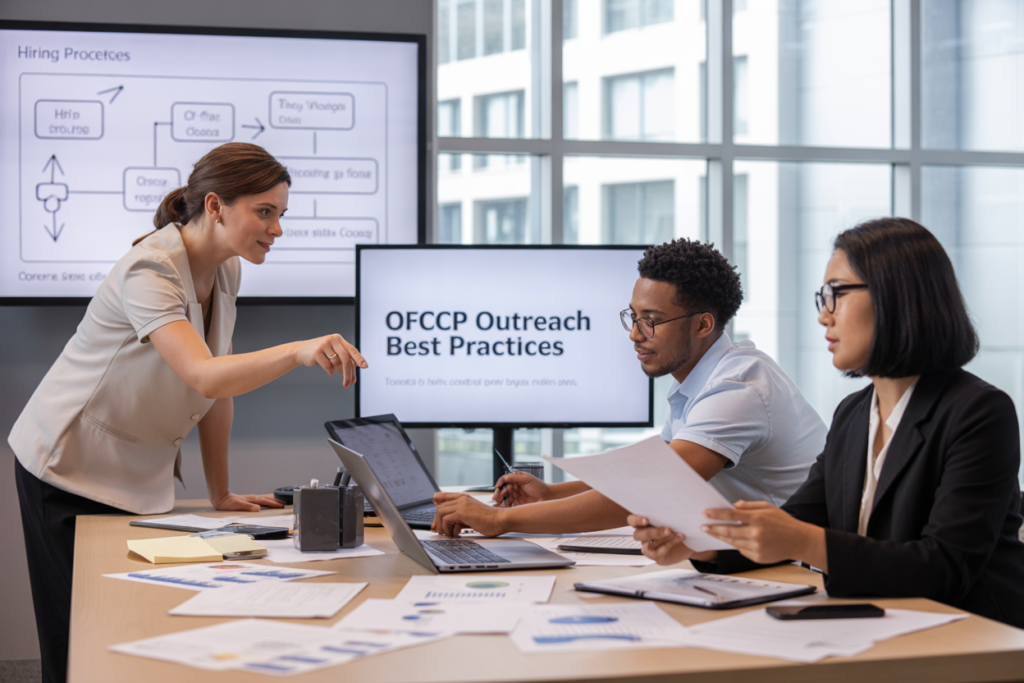
When you’re a federal contractor facing 100-plus job openings, your OFCCP outreach responsibilities multiply fast. Managing high-volume hiring compliance while meeting tight deadlines can feel overwhelming without the right approach.
This guide is designed for HR teams, compliance officers, and talent acquisition professionals at federal contractors who need to scale their recruitment efforts while staying compliant. You’ll learn proven OFCCP outreach best practices that work when hiring at scale.
We’ll cover how to identify and prioritize high-impact outreach sources that deliver maximum candidate reach for your efforts. You’ll also discover streamlined documentation systems that keep your OFCCP compliance organized without drowning in paperwork. Finally, we’ll show you how to measure your outreach performance so you can continuously improve your mass hiring compliance strategy.
The key is building systems that work efficiently at scale while maintaining the thorough documentation OFCCP requires. Let’s dive into the strategies that will transform your large-scale OFCCP outreach from chaos into a well-oiled machine.
Scale Your OFCCP Compliance Strategy for High-Volume Hiring
Develop standardized outreach processes that work across multiple positions.
Building a solid foundation for high-volume hiring compliance starts with creating processes that work consistently across all your open positions. Instead of reinventing the wheel for each role, develop template workflows that you can customize quickly for different departments or job families. This approach saves significant time while ensuring your OFCCP recruitment strategies remain consistent and defensible.
Start by mapping out your core outreach activities – which sources you’ll contact, what information you’ll request, and how you’ll document responses. Create standard email templates for reaching out to community organizations, trade associations, and educational institutions. These templates should include your company’s commitment to diversity and equal opportunity, while remaining flexible enough to be personalized for specific partnerships.
Consider grouping similar positions in your outreach efforts. When recruiting for multiple engineering roles or several administrative positions, you can often use the same outreach sources and messaging. This bundling approach makes your federal contractor hiring requirements more manageable while building stronger relationships with your outreach partners.
Create automated tracking systems for documentation requirements.
Manual tracking becomes impossible when you’re managing large-scale OFCCP outreach efforts across dozens of positions. Invest in systems that automatically capture and organize your outreach documentation from day one. Your tracking system should record every contact attempt, response received, and referral generated without requiring manual data entry for each interaction.
Set up automated workflows that trigger specific documentation requirements based on your recruitment timeline. For example, configure alerts that remind your team to document outreach efforts within 48 hours of posting a position, or automatically generate compliance reports showing your progress toward meeting federal contractor recruitment goals.
Your OFCCP documentation systems should integrate with your applicant tracking system to create a seamless workflow. When candidates apply through specific outreach sources, this information should automatically link back to your outreach efforts, creating a clear audit trail that demonstrates the effectiveness of your compliance activities.
Establish clear timelines and milestones for large-scale recruitment efforts.
Mass hiring compliance strategy requires precise timing coordination across multiple moving parts. Create detailed project timelines that account for the increased complexity of managing numerous positions simultaneously. Your timeline should include specific milestones for outreach initiation, follow-up activities, and documentation deadlines.
Break down your recruitment timeline into phases that align with OFCCP outreach best practices. Phase one might focus on high-impact, broad-reach sources that can support multiple positions. Phase two could target specialized organizations relevant to specific roles. This phased approach prevents your team from becoming overwhelmed while ensuring comprehensive coverage.
Build buffer time into your schedules to accommodate the unpredictable nature of large-scale recruitment. Community organizations and outreach partners may need additional time to respond when you’re requesting support for multiple positions. Planning for these delays keeps your overall timeline on track.
Build dedicated compliance teams to manage the increased workload
The workload spike from bulk OFCCP compliance hiring often overwhelms teams trying to handle everything with existing resources. Designate specific team members to focus exclusively on compliance activities during major hiring initiatives. This dedicated approach ensures your outreach efforts receive proper attention while maintaining quality standards.
Structure your compliance team with clear role definitions. One person might specialize in building relationships with OFCCP outreach sources, while another focuses on documentation and record-keeping. A third team member could handle coordination between hiring managers and compliance requirements. This specialization improves efficiency and deepens expertise within your organization.
Train your compliance team members to become subject-matter experts across different aspects of the process. Having specialists who understand the nuances of working with veterans’ organizations, disability advocacy groups, or minority business associations creates more effective partnerships and better compliance outcomes across all your hiring efforts.
Target High-Impact Outreach Sources for Maximum Reach
Partner with universities and community colleges for direct pipeline access
Building relationships with educational institutions creates a steady stream of qualified candidates for your high-volume hiring needs. Universities and community colleges serve diverse student populations, making them ideal partners for OFCCP outreach best practices. Start by connecting with career services offices at schools that offer programs relevant to your industry.
Establish formal partnerships through internship programs, co-op opportunities, and campus recruiting events. Many schools host regular job fairs specifically designed to connect employers with students from underrepresented backgrounds. These events align perfectly with federal contractor hiring requirements while giving you access to emerging talent.
Don’t overlook community colleges, which often serve first-generation college students and working adults seeking career transitions. These institutions frequently have strong connections to local workforce development initiatives and can help you reach candidates who might not appear through traditional recruiting channels.
Consider sponsoring student organizations, offering guest lectures, or providing mentorship opportunities. These activities build your employer brand while demonstrating genuine commitment to diversity and inclusion – something OFCCP compliance teams value highly.
Leverage professional associations and industry-specific organizations.
Professional associations represent goldmines for large-scale OFCCP outreach efforts. These organizations often have diversity-focused chapters or special-interest groups that can help you connect with qualified professionals from diverse backgrounds.
Research associations that specifically support underrepresented groups in your industry. For example, if you’re in technology, consider partnering with organizations such as the National Society of Black Engineers, the Society of Hispanic Professional Engineers, or Women in Technology International. Each partnership expands your reach while supporting your bulk hiring OFCCP compliance goals.
Many professional associations offer job boards, career centers, and networking events exclusively for their members. These platforms typically attract experienced professionals actively seeking new opportunities. Since members often pay dues and maintain active participation, they tend to be more engaged and motivated candidates.
Don’t forget about local chapters of national organizations. These groups often have smaller, tight-knit communities where your job postings can receive more personalized attention. Local chapter leaders frequently know their members well and can provide valuable insights about matching candidates to specific roles.
Use social media platforms for broader demographic engagement
Social media platforms offer unparalleled reach for your OFCCP recruitment strategies. LinkedIn remains the go-to platform for professional networking, but don’t stop there. Different demographics favor different platforms, so diversifying your approach helps you cast a wider net.
Facebook groups focused on specific professions or career transitions can yield excellent results. Many of these groups have active job-sharing cultures where members regularly post and share opportunities. Join groups that align with your industry and target demographics, then participate authentically before sharing job opportunities.
Twitter (X) and Instagram work particularly well for reaching younger professionals and creative professionals. Use relevant hashtags to increase visibility and engage with industry conversations. Video content on platforms like TikTok and YouTube can showcase your company culture while attracting candidates who value workplace transparency.
Create social media content that highlights your commitment to diversity and inclusion. Share employee stories, showcase your workplace culture, and post about community involvement. This approach builds trust with potential candidates while demonstrating the values that underpin your mass-hiring compliance strategy.
Connect with government workforce development programs.
Government workforce development programs represent untapped potential for many federal contractors. These programs specifically focus on helping underemployed and unemployed individuals develop skills and find meaningful work – exactly what OFCCP outreach sources should target.
American Job Centers, operated under the Workforce Innovation and Opportunity Act, are available in communities nationwide. These centers serve job seekers from diverse backgrounds and often have relationships with local employers. Staff members understand the unique needs of different populations and can help match candidates to your specific requirements.
State and local workforce development boards often run specialized programs for veterans, individuals with disabilities, and other protected groups. These programs frequently include skills training components, meaning participants arrive job-ready and motivated to succeed.
Partner with apprenticeship programs in your area. These initiatives combine classroom learning with hands-on experience, creating a pipeline of skilled workers while supporting community economic development. Many apprenticeship programs prioritize diversity and inclusion, making them natural allies for your OFCCP compliance efforts.
Don’t overlook reentry programs that help formerly incarcerated individuals transition back into the workforce. These programs often produce highly motivated candidates who appreciate second chances and tend to show strong loyalty to employers who give them opportunities.
Streamline Documentation and Record-Keeping Systems
Implement digital tracking tools for all outreach activities.
Managing OFCCP outreach for 100+ openings without robust digital tracking is like juggling while blindfolded. Digital tracking tools transform chaotic documentation into organized, searchable records that auditors actually appreciate. Modern OFCCP documentation systems automatically capture every email sent, every job board posting, and every recruitment event attended, with timestamps and recipient details logged.
Cloud-based platforms, such as applicant tracking systems (ATS) integrated with outreach modules, enable seamless workflows that let recruitment teams launch campaigns across multiple sources. In contrast, the system documents everything in the background. These tools eliminate the guesswork around which sources received which communications and when follow-ups occurred.
The real power comes from customizable dashboards that show outreach progress across all positions simultaneously. Instead of digging through scattered spreadsheets, compliance officers can instantly see which openings have met their outreach requirements and which need immediate attention. Smart notifications alert teams when outreach deadlines approach or when specific sources haven’t been contacted within required timeframes.
Create standardized templates for outreach communications.
Cookie-cutter approaches rarely work in recruitment, but standardized templates provide the foundation for consistent, compliant outreach while allowing customization for specific roles. Well-crafted templates ensure every communication includes essential compliance elements, such as equal opportunity statements and application instructions, while maintaining a professional tone across all correspondence.
Effective OFCCP outreach templates include modular sections that teams can mix and match based on the audience and position type. A template library might include variations for professional associations, community organizations, educational institutions, and specialized recruitment sources. Each template maintains core compliance language while allowing customization for industry-specific terminology and role requirements.
Template standardization becomes particularly valuable when multiple team members handle outreach simultaneously. New recruiters can quickly learn proper communication protocols, and seasoned staff can work more efficiently without having to recreate basic structures. Version-control features in template systems ensure everyone uses the latest, compliant language that reflects the latest OFCCP guidance.
Establish centralized databases for contact management.
Scattered contact lists across different team members’ computers create compliance nightmares and missed opportunities. Centralized databases for OFCCP outreach sources transform fragmented information into strategic recruitment assets that deliver measurable results for high-volume hiring compliance.
A comprehensive contact management system organizes sources into categories such as professional associations, community groups, educational institutions, and specialized recruitment organizations. Each contact entry includes detailed information on past interactions, response rates, and the types of positions that yielded the best results for each source.
The database becomes more valuable over time as teams track which sources consistently provide qualified candidates for different role types. This historical data drives smarter outreach decisions, helping recruitment teams focus energy on proven sources while gradually expanding to new contacts. Regular database maintenance keeps information current and removes outdated contacts that no longer serve recruitment goals.
Integration with email systems allows teams to launch targeted campaigns directly from the database while automatically logging all communications. Advanced systems can segment contacts based on criteria like geographic location, industry focus, or candidate demographics to ensure outreach aligns with specific position requirements.
Develop automated reporting mechanisms for compliance audits
Manual report generation for large-scale OFCCP outreach creates bottlenecks
Maximize Efficiency Through Strategic Timing and Coordination
Coordinate multiple job postings to reduce redundant outreach efforts
Smart coordination prevents your OFCCP outreach best practices from becoming a scattered mess when handling bulk hiring compliance. Rather than posting each opening individually and contacting the same organizations repeatedly, group related positions together for streamlined communication. This approach dramatically reduces administrative burden while maintaining comprehensive coverage of your federal contractor hiring requirements.
Create master outreach lists that categorize positions by department, location, or skill set. When reaching out to disability advocacy groups, veterans’ organizations, or minority professional associations, present your entire slate of relevant opportunities in one communication. This strategy respects recipients’ time while showcasing the full scope of career paths available within your organization.
Your large-scale OFCCP outreach becomes more professional and effective when contacts receive a single, well-organized message rather than multiple scattered emails about similar roles. Partners appreciate this consolidated approach and are more likely to share comprehensive opportunity lists with their networks, expanding your reach exponentially.
Schedule outreach activities during peak engagement periods
Timing transforms mediocre outreach into powerful recruitment tools for your high-volume hiring compliance strategy. Research shows that different demographic groups and professional organizations have distinct peak engagement periods throughout the week and year. Veterans’ organizations typically see higher email open rates on Tuesday through Thursday mornings, while disability advocacy groups often have better response rates during the first two weeks of each month.
Professional associations serving minorities often experience peak engagement during the early fall and spring, coinciding with conference seasons and networking events. Schedule your federal contractor recruitment outreach to align with these patterns to maximize visibility and response rates.
Consider seasonal hiring patterns within your industry, too. If you’re recruiting for positions that start in January, launch your outreach campaigns in October and November when candidates are actively planning career moves. This strategic timing ensures your OFCCP recruitment strategies capture attention when candidates are most receptive to new opportunities.
Batch similar positions for consolidated recruitment campaigns
Transform individual job postings into powerful recruitment campaigns by grouping similar positions under unified themes. Instead of promoting 15 separate customer service roles, create a “Customer Excellence Career Fair” campaign that highlights career progression opportunities across multiple departments. This approach makes your mass hiring compliance strategy more appealing to candidates while simplifying your documentation requirements.
Batching positions allows you to develop targeted messaging that speaks directly to specific candidate pools. Group all your IT positions for outreach to technology diversity organizations, while bundling healthcare roles for medical professional associations. This focused approach makes your outreach more relevant and compelling to recipients.
Create campaign-specific landing pages that showcase multiple opportunities within each batch, complete with transparent application processes and OFCCP documentation systems integration. Candidates can explore various options that match their skills and interests, increasing application rates while reducing your administrative workload. This method also helps ensure consistent messaging across all positions within each batch, strengthening your overall recruitment brand.
Measure and Optimize Your Large-Scale Outreach Performance
Track response rates across different outreach channels
When you’re managing OFCCP outreach best practices for 100+ openings, you need crystal-clear data on which channels actually deliver results. Start by establishing baseline metrics for each outreach source before your campaign launches. Your tracking system should capture response rates from job boards, professional associations, community organizations, and social media platforms separately.
Create a simple spreadsheet or dashboard that shows weekly response rates by channel. This helps you spot trends quickly and reallocate budget from underperforming sources to high-impact channels. Many federal contractor recruitment teams discover that specialized diversity job boards outperform general platforms by 3-4x for qualified candidates, but you won’t know your specific results without proper tracking.
Don’t forget to measure response quality, not just quantity. A channel generating 100 responses with 5% qualified candidates performs worse than one delivering 30 responses with 40% qualification rates. Track both metrics to inform future decisions about your OFCCP outreach sources.
Monitor demographic diversity in your applicant pool
Large-scale OFCCP outreach requires constant monitoring of demographic composition throughout your hiring process. Set up weekly check-ins to review diversity metrics across all active requisitions. Your tracking should include gender, race/ethnicity, veteran status, and disability status at each funnel stage.
Build alerts that notify you when demographic representation drops below acceptable thresholds for specific job families or locations. This early warning system lets you pivot quickly and intensify outreach to underrepresented groups before it becomes a compliance issue.
Use visual dashboards that show demographic trends over time. Many teams find that specific outreach channels consistently deliver stronger diversity metrics, while others skew toward particular demographics. This intelligence helps you balance your channel mix strategically rather than hoping for the best.
Analyze cost-per-hire metrics for budget optimization.
High-volume hiring compliance demands smart budget allocation across your outreach portfolio. Calculate true cost-per-hire for each channel by including both direct costs (job board fees, association memberships) and indirect costs (staff time, materials, events).
Track these metrics monthly and compare performance across similar role types. You might discover that premium job board placements cost 40% more but deliver hires 60% faster, creating net savings when you factor in extended vacancy costs. Or you could find that community partnership events require more upfront investment but generate higher-quality candidates with better retention rates.
Create a simple ROI calculation that weighs cost-per-hire against quality metrics like 90-day retention, performance ratings, and time-to-productivity. This comprehensive view helps you invest your federal contractor hiring requirements budget where it generates the most value.
Assess time-to-fill improvements from enhanced outreach efforts
Your bulk hiring OFCCP compliance strategy should dramatically improve time-to-fill metrics when executed properly. Establish baseline time-to-fill measurements before implementing new outreach approaches, then track improvements across different job families and locations.
Break down time-to-fill into parts: time from posting to first qualified applicant, time from qualified applicant to interview, and time from interview to offer acceptance. This granular view shows you where enhanced outreach has the most significant impact and where bottlenecks still exist in your process.
Compare time-to-fill performance between positions that used your enhanced outreach strategy versus those that relied on traditional methods. Document these improvements for future budget justifications and process refinements. Many organizations see 25-40% improvements in time-to-fill when they implement strategic, multi-channel outreach approaches for large hiring initiatives.
Track seasonal variations and market conditions that affect these metrics. Your outreach performance data becomes invaluable for planning future high-volume hiring cycles and setting realistic expectations with hiring managers.
Managing OFCCP compliance across 100+ openings doesn’t have to be overwhelming when you have the right strategy in place. The key is building a scalable system that targets high-impact outreach sources, keeps your documentation organized, and leverages timing to maximize your reach. When you coordinate your efforts strategically and track what’s working, you’ll find that large-scale compliance becomes much more manageable.
Success with high-volume OFCCP outreach comes down to working smarter, not harder. Start by identifying your most effective outreach channels, set up automated systems for documentation, and regularly review your performance data to fine-tune your approach. With these practices in place, you’ll not only meet compliance requirements but also build stronger, more diverse talent pipelines that benefit your organization in the long term.
Expanding candidate pipelines requires automation that simplifies posting and amplifies reach. Explore our LinkedIn, Craigslist, and WayUp integrations to target a wide range of talent, and browse the Programmatic Job Advertising category for insights on optimizing spend and visibility. Whether you’re scaling national campaigns or managing regional hiring, Job Multiposter and Job Distribution streamline automation and drive stronger recruiting outcomes.


